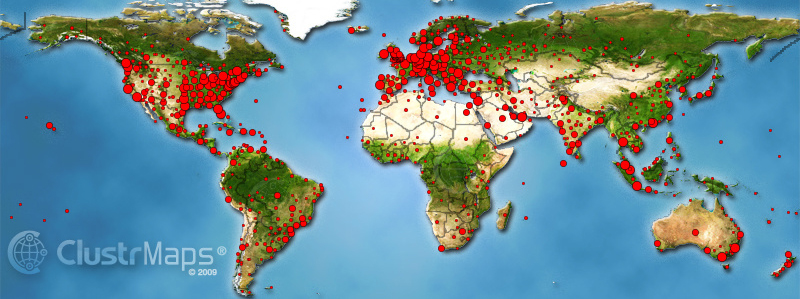
… with more than 453,000 unique visitors worldwide…
Picture is courtesy of ClustrMaps.com…

1. Soft Reboot
Orange Key + Sym Key + R2. Make Screenshot
Orange Key + Sym Key + P3. Num Lock
Orange Key4. Caps Lock
Shift Key5. Highlight Text
Shift Key and mark text on screen6. Copy Text to Clipboard
C Keyon keyboard to copy7. Cut Text to Clipboard
X Key on keyboard to cut8. Paste Text from Clipboard
V Key on keyboard to pasteMicrosoft seems to be putting lots of money into their geo mapping services. They are not only integrating 3D views, that can be zoomed fluently into, they are integrating real time recordings and historical pictures as long as they contain geo data. If that is not enuff for you: they also integrated the view on the stars that of course changes when you move or adjust the time.
A little too much information? Check this presentation by Microsoft Live Labs’ architect Blaise Aguera y Arcas – also known as the creator of Photosynth, the technology that is now being integrated into Bing Maps.
Well, do you still think there is need for Linden’s Second Life?
1. Demoing Bing 3D Maps (courtesy of TED.com)…
2. Demoing Photosynth in 2007 (also courtesy of TED.com)…
YouTube might have disabled access to this song from some countries… Did we tell you about swedish VPN services yet? No? Ok, we’re gonna catch up on that soon ;-)
Links
» Wikipedia.org: Dukes of Windsor…
» MySpace.com: Dukes of Windsor…
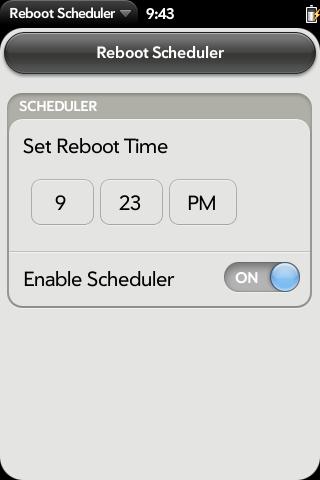
Many of us know the phenomenon. The longer we use the iPhone or the Palm Pre the slower it goes. Rebooting the system always helped on either device.
For the Palm Pre there is now a solution that is called Reboot Scheduler by Zinge, which allows to automize the reboot process and to schedule it to a certain time.
We feel this is a nice tool for people running homebrew apps on their Pre anyway. You find it via the PreCentral repository.
That’s what we really like about the Palm Pre WebOS platform: it embraces the homebrew developers. No jailbreaking, no hassle.
Kudos fly out to Zinge and the PreCentral team.
Links
» PreCentral.net: Palm Pre Reboot Scheduler…
Screenshot is courtesy of PreCentral.net…
Obviously notorious George Hotz has managed to get all 7 SPUs of the Playstation 3’s CPU under his control. This means although he cannot access the CPU’s root key, he now can decrypt everything that’s going thru these SPUs like datastreams of (encrypted) commercial games.
The PPU is higher on the control chain then the SPUs. Even if checks were to be added to, for example, verify the hypervisor before decrypting the kernel, with clever memory mappings you can hide your modified hypervisor.
In the meantime another hacker going under the nick XorLoser has released a more detailed manual of how to use GeoHot’s exploitation files and how to do the glitching.
Besides that XorLoser maintains a plugin for reverser’s beloved Interactive Disassembler (IDA) that contains special PPC instructions for Xbox360 and PS3.
Congratulations to GeoHot. Kudos fly out to XorLoser.
Links
» GeoHot: On Isolated SPUs…
» XorLoser: PS3 Exploit – Software…
» XorLoser: PS3 Exploit – Hardware…
» XorLoser: PS3 and Xbox360 IDA PlugIn…
» Hex-Rays.com: IDA Pro…
Following an approach of explaining biological processes on earth the Gaia theory says (the surface) of planet earth including its biosphere can be viewed as a single living organism that every life form is a part of. Sounds familiar? Yes, I bet you’ve watched Avatar in cinema.
The Gaia theory has been developed by biologists Lynn Margulis and James Lovelock in the 1960s. According to them the biosphere as the whole of all organisms creates and maintains conditions required for life and evolution.
Lovelock, however, defines life as a self-preserving, self-similar system of feedback loops like Humberto Maturana’s autopoiesis; as a self-similar system, life could be a cell as well as an organ embedded into a larger organism as well as an individual in a larger inter-dependent social context.
(qt: wikipedia.org)
Links
» GaiaTheory.org
» Wikipedia.org: Gaia Hypothesis…
» Ecolog.org: Lovelock…
The Open University has compiled a documentary about that theory featuring Lovelock himself:
On the Black Hat 2010 conference in Crystal City notorious smart card hacker Christopher Tarnovsky explained how he managed to hack current Trusted Platform Modules by Infineon.
This time Tarnovsky managed to read secured data from TPM chips like RSA and DES crypto keys. His approach took six months and a lab consisting of devices for about US$ 200,000. After having found out the exacty way to compromise Infineon’s chips it took only six hours to compromise an XBox 360’s TPM chip.
On the Black Hat 2008 in Amsterdam Tarnovsky said he was offered US$ 100,000 to crack the Xbox 360’s TPM:
A Microsoft engineer is wondering: “Did you take an interest in the processor of our Xbox360 game console?” – “I was offered 100’000 dollars to break it”, says Tarnovsky. “But I replied that that wasn’t enough.”
For people generally interested in approaching smart card security check this article with a video Wired.com featuring Tarnovsky in his security lab.
Security experts from the Computer Laboratory of the University of Cambridge have compromised the electronic autorization and verification process of major credit and debit cards like EC-Card, Eurocard, Mastercard and VISA (EMV).
The computer scientists team around Steven Murdoch found a flaw in the in the EMV protocol which allows criminals to use a stolen genuine card to make a payment without knowing the card’s PIN.
Using a man-in-the-middle attack they trick the electronic terminal into believing the PIN was verified correctly while telling the terminal to step back into signature based authorization mode.
This being said, credit card companies and banks worldwide will not be able to hide behind the phrase that their systems are secure and that customers who have been stolen credit cards have not observed the rule to destroy their credit card’s PIN. Insurance companies take care: customers recurse receivables against issueing banks are coming.
Links:
» IEEE Symposium on Security and Privacy: Chip and PIN is Broken (PDF)…
» BBC.co.uk: New flaws in chip and PIN system revealed…
» University of Cambridge: Computer Laboratory…
Documentary is courtesy of BBC.co.uk…
Plastic Planet is an documentary about how plastic materials have become a global threat of life. The movie has been directed by Werner Boote from Austria.
Plastic Planet shows how the industry keeps the chemical composition of plastic products top secret. It also explains that one of the plastic ingredients is Bisphenol A (BPA). BPA is found in many things of our everyday life’s like plastic bottles and baby pacifiers. Among scientists BPA is well known to be posing a threat to health. In January 2010 the U.S. american Food and Drug Administration (FDA) released a statement on BPA:
(..) on the basis of results from recent studies using novel approaches to test for subtle effects, both the National Toxicology Program at the National Institutes of Health and FDA have some concern about the potential effects of BPA on the brain, behavior, and prostate gland in fetuses, infants, and young children (..)
Plastic Planet’s soundtrack is provided by the ambient and dub pioneers of The Orb.
After Let’s Make Money by Erwin Wagenhöfer, Werner Boote seems to be the next austrian filmmaker to help describing downsides of the globalization.
We currently don’t have information how or when this movie is coming to a cinema in the U.S.
» Wikipedia: Bisphenol A…
» U.S. Food and Drug Administration: Update on Bisphenol A January 2010…
» IMDB.com: Plastic Planet…
» Wikipedia: Werner Boote (german)…
Plastic Planet Trailer (german):
Austrian TV documentary about health risks of plastics (german only):